Welcome
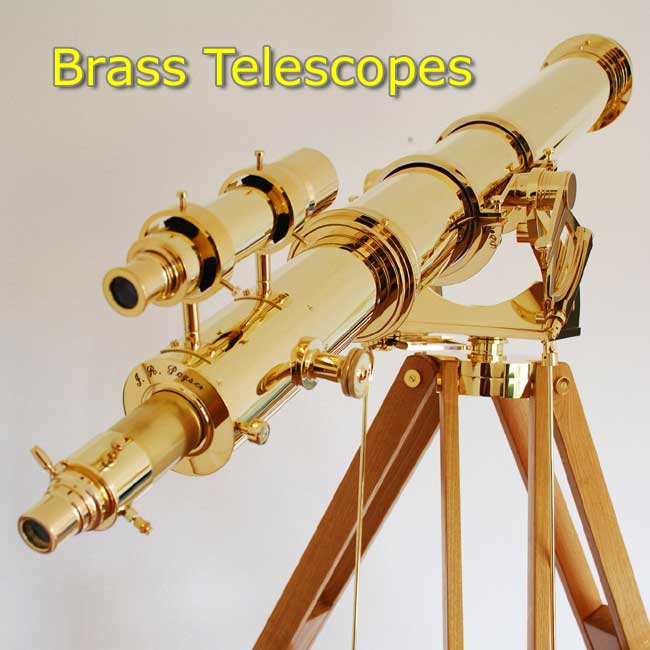
We make superb brass refracting telescopes in the traditional style.
As you go through this web site you will see pictures of the types
of telescope that we make. They are all individually made to suit
our customers' wishes and are designed to look wonderful, as well
giving excellent optical performance. We have set ourselves the
challenge of continuing the fine tradition begun by makers such
as Cooke, Dollond and Watson.
| We
make accessories for telescopes.
 |
As you will see further
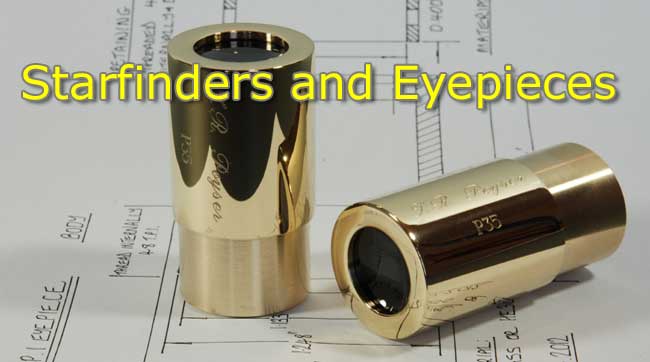
on, we mostly work in brass. We make brass finder telescopes
and matching brackets, as well as brass
Plossl eyepieces. We make specialist eyepiece adapters
and special star diagonals. We can make you a star diagonal
that inverts the image completely, turning your astronomical
telescope into a terrestrial instrument, or we can make
you a star diagonal in which the image is still a true
astronomical image, i.e. upside down and back to front.
|
|
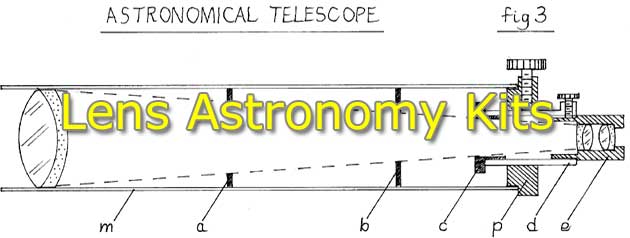
We supply GCSE
Astronomy Kits.
 |
We supply a kit
of three lenses for those people who need to build
a small telescope as part of their coursework.
The lenses are an achromatic doublet for the objective
lens and two, planoconvex lenses to make a Ramsden
eyepiece.
|
|
| We supply optical
components.
We can supply objective lenses for
large refractors and we have a huge stock of smaller lenses,
so that you can make yourself a finder telescope, for example,
or eyepieces. Our larger lenses are all brand new, but the
smaller lenses are often of military origin and of very high
quality.
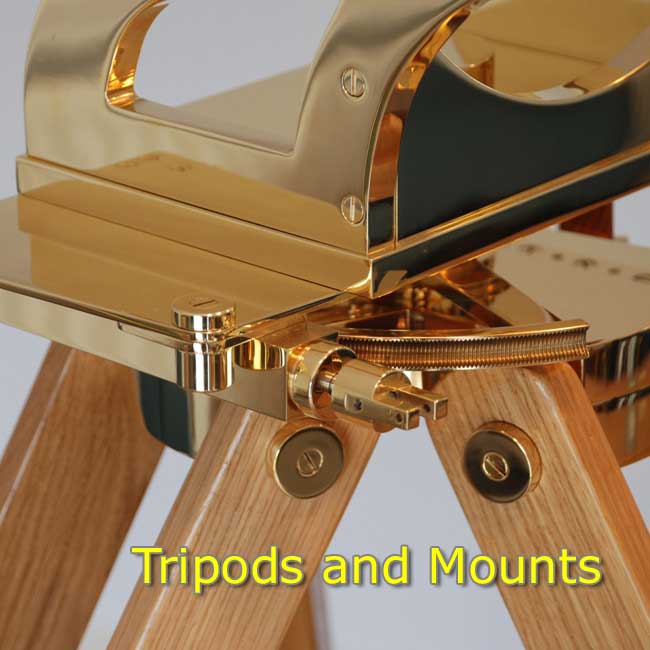
We make telescope tripods
Our tripods are made of hardwood
(oak or mahogany, for example) and brass. They are designed
to suit the style of our own brass refractors. We can provide
either altazimuth or equatorial heads. These tripods are large
and are suitable for refracting telescopes |
We supply ex
Government optical components.
|
A little about us
Our telescope making business started in 1981, in the city of Rochester,
in Kent. It was originally known as I. R. Poyser (Engineering).
We made small astronomical telescopes using 76mm diameter lenses
with a focal length of 480mm.Those f/6.3 refracting telescopes were
particularly popular at the time.
We also sold optical components such as lenses and prisms to those
enthusiasts who liked making their own instrumentation. We acquired
a good reputation as suppliers of ex government optical devices,
such as tank periscopes, gun sights and anything that could be used
for astronomy. We extended our range of telescopes to include 76mm
refractors with a 1000mm focal length and for a while we made some
rather beautiful 'officer of the watch' telescopes. They were two
or three draw nautical telescopes that had polished, engraved brass
drawtubes and were bound in dark red, 'antique' leather.
We moved to new premises in Dale Road, in Rochester, which some
of you may remember. The business flourished and we made the 'Rochester'
range of brass refracting telescopes. The lens cells of the telescopes,
76mm or 100mm, were in polished brass, as were the engraved back-plates
and drawtubes, while the main tubes of the telescopes were made
of aluminium alloy, stove-enamelled in a lustrous dark blue. (The
firm of enamellers operated from the back of a garage, miles out
in the Kent countryside!) During those fifteen years in Dale Road
the name of the company changed to simply I. R. POYSER.
In 2002 we moved to Mid Wales, to the beautiful hamlet of Ystrad
Meurig, where we now make our superb brass refracting telescopes
and, if you require, our impressive oak and brass tripods to go
with them.
We still make specialist telescope components for customers. We
are proud to say that we have made some brass components for the
720mm refractor at the Royal Observatory in Greenwich and its
6" guide 'scope. We make our brass Plossl eyepieces and we
still supply optical components such as lenses, mirrors and prisms.
We have a thriving trade in ex government eyepieces and we supply
GCSE lens kits to those students who are studying the GCSE Astronomy
course.
Thank you for taking the time to read a little of our story. It
is quite astonishing that it has been almost a quarter of a century
since it all started.
Enjoy our website and, if you are new to astronomy, we hope it
will encourage you in your own journey to the stars.
Ian Poyser.
|